
Xuanzang 玄奘
(602–664) is likely the most famous of Chinese
Buddhist monks who traveled to India to pursue studies and retrieve
texts. He stayed in India between 633–645 and upon returning to
China enjoyed patronage from an imperial government engaged in
aggressive expansionist conquests (see here).
There were therefore ample resources directed his way to support his
translation work. In the following decades another generation or two
of Chinese monks followed in his footsteps and made their way to
India. None of them became as famous as Xuanzang, but nevertheless
some of them made significant contributions to the development of
Buddhism in East Asia. The modern historian can also learn a great
deal about the India of the time from not only their direct accounts
and travelogues, but also short remarks in margins and colophons. One
problem in reconstructing the history of ancient India is the paucity
of contemporary accounts and historical documents, which is why
Indologists since the nineteenth century have often had to rely on
surviving accounts by Chinese travelers.
One Chinese traveler to India who is
less known but nevertheless was quite important was a certain monk by the
name of Wuxing 無行 (b. 630).
He was from Jiangling 江陵 in
Jingzhou 荊州 (modern Hubei).
He also had a Sanskrit name of Prajñādeva, a custom which seems to
have been fairly common among Chinese monks in the Tang dynasty. It
seems he was an erudite scholar monk, having studied under Huiying
慧英, who was a disciple of
the Chinese Madhyamaka author Jizang 吉藏
(549–623). He also traveled or wandered around China before
also studying under Daoxuan 道宣
(596–667), who was the leading scholar and advocate of the
vinaya in China.
At some point he decided to travel to
India. His account is preserved in a collection of biographies of
monks in the early Tang who went to India in pursuit of the Dharma
(大唐西域求法高僧傳; T
2066), which was compiled by Yijing 義淨
(635–713). Yijing himself was a very successful scholar and
translator. Like Xuanzang, he studied in India and returned to
translate an enormous quantity of Buddhist literature into Chinese,
in particular the entire Mūlasarvāstivāda Vinaya and related
texts. He also penned a lengthy travelogue detailing his own journey
through India. This was incidentally translated into English 1896 by
Takakusu and can be viewed here.
Yijing left China in 671 and returned
in 695, spending time in both India and the Indonesian archipelago.
The latter at the time had a thriving Buddhist sangha apparently
closely modeled on the Indian system. Just like in the Tarim Basin
Buddhist states, they also studied Sanskrit to full literacy. Chinese monks, we are
told, would go there to learn Sanskrit before traveling onward to
India. My impression is that given its central location between the
sea routes linking trade between India and China, they probably had
sufficient numbers of bilingual scholars to provide a suitable
environment for Chinese monks to learn sufficient Sanskrit, both its
spoken and written forms. The elites were also favorable towards
Chinese interests, which likely stemmed from the lucrative trade and
prestige provided by China.
Wuxing also traveled to India through
SE Asia. Together with another monk named Zhihong 智弘
he initially arrived in *Śrībhuja 室利佛逝
before sailing onward to eastern India. He initially had to
find a benefactor, which Yijing said was “somewhat difficult” in
the western country. A guest monk was entitled to be fed, but nothing
more. We can imagine locals happily surprised to meet a bhikṣu from
the remote land of Mahācīna ('Great China'), but one has to wonder
to what extent they would have been regarded as capable scholars. Even if they were well read in Buddhist literature in Chinese
translation, how well could they communicate in Sanskrit or local
languages? Although they had traveled a great distance, we might
imagine locals not necessarily feeling inclined to pay for their
education and living expenses at a prestigious institution like
Nālandā.
Wuxing nevertheless managed to find a
patron and studied a number of subjects at Nālandā including
Yogācāra, Madhyamaka, the Abhidharmakośa-bhāṣya and the
vinaya. This might also indicate the primary or popular subjects
being studied there in the second half of the seventh century. Later
he moved to a nearby monastery *Tilaśākya 羝羅荼寺
where he studied logic including the works of Dignāga and
Dharmakīrti.
Sometime during his stay in this area
he also met his compatriot Yijing. Wuxing and Yijing were just two of apparently
several other known Chinese monks studying and wandering around India
at the time. At the time there were three main routes to reach India from China:
- Through the Tarim Basin and then
coming down through the Hindu Kush or western Himalayas.
- Through Tibet and Nepal and then
south into India, though this route was only generally available when
diplomatic relations allowed for it as Tang China and Yarlung Tibet
were often at war.
- Coming down from southern China by
sea to Indonesia and then sailing west to Sri Lanka or the eastern
Indian coast.
In the seventh century there were also
several diplomatic envoys from China that reached India (for some
details see here).
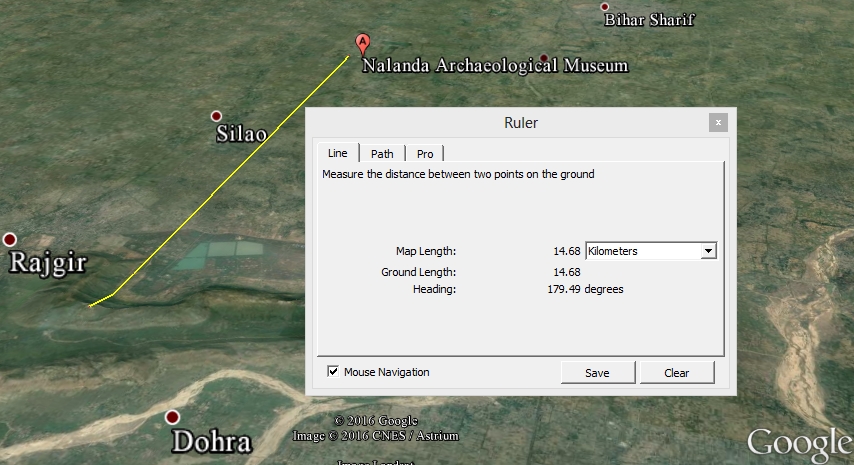
Yijing tells us that he went with
Wuxing to visit Gṛdhrakūṭa (Vulture's Peak). The distance
between Nālandā and Gṛdhrakūṭa is around 15 km, so it probably
took them a day to walk there. It was a memorable experience for
Yijing and he remarks how they lamented being born so late and only
seeing the ruins of places mentioned in scriptures.
Wuxing also told Yijing that he wanted
to stay in India, but he was also inclined to return to China through
northern India. When Yijing left Nālandā, Wuxing saw him off.
Wuxing at the time was fifty-six years old. This parting happened in
year 1 of Chuigong 垂拱元年 (685)
and Yijing notes at the time of writing in 691 that he was unaware of
where Wuxing was or if he was still alive.
This is not however the last we hear of
Wuxing. Zhisheng 智昇 (669–740)
in his catalog of Buddhist texts compiled in 730 (開元釋教錄
T 2154) reports the following:
「沙門無行西遊,天竺學畢言歸迴。至北天不幸而卒。所將梵本有勅迎歸。比在西京華嚴寺收掌。無畏與沙門一行,於彼簡得數本梵經,並總持妙門,先未曾譯。至十二年隨駕入洛,於大福先寺安置。遂為沙門一行譯大毘盧遮那經。」
The śramaṇa
Wuxing had traveled west and upon completing his studies in India
said he would return. He unfortunately died in northern India. It was
ordered that the Sanskrit texts he carried be retrieved. These were
deposited at Huayan-si in the western capital [Chang'an].
Śubhakarasiṃha [637–735] and Yixing 一行
[683–727] selected a number of Sanskrit scriptures there
plus dhāraṇī practices. They had previously never been
translated. In year 12 [724] they followed the emperor to Luoyang
where they were posted to the temple Dafuxian-si. The
Mahāvairocana-sūtra was subsequently translated by śramaṇa
Yixing [and Śubhakarasiṃha].1
It therefore would appear that the
Sanskrit edition of Mahāvairocana-sūtra that
Śubhakarasiṃha's team translated into Chinese was based on the
edition carried by Wuxing who had perished in northern India.
Although this account may be spurious, all of the modern scholars I
have surveyed so far accept it as plausible. I think it is plausible
too because the account was written down only a few years after the
translation was completed. In addition, there is a seldom cited
source which is the letter Wuxing sent to China from India.
At one
point in India he translated an account excerpted from the
Sarvāstivāda Vinaya 一切有部律
of the
Tathāgata's nirvāṇa
涅槃
in three
fascicles which was forwarded to China. It is unclear to me who
conveyed this back to China (it was perhaps Yijing). He might also
have forwarded his letter to the Chinese sangha with this text.
Regardless of who delivered it to China, it was preserved and
eventually more than a century later a copy of it was brought back to
Japan by the Tendai monk Ennin 圓仁
(794–864). He includes Wuxing’s letter to China from India
(南荊州沙門無行在天竺國致於唐國書一卷)
in his record of texts brought back from China.
Unfortunately, it seems the letter is
not extant. However, a single line from it is fortunately quoted by the Japanese monk Annen 安然
(841–915?) in his Shingon shūkyō jigi
眞言宗教時義:
“Recently the new Mantra teachings have become revered in the
country” 近者新有眞言教法擧國崇仰.2
This simple remark is actually very
historically significant. Xuanzang, who returned to China in 645,
never mentions Mantrayāna in India. Some have speculated this might
have been because he was interested in other subjects, but he was
also interested in dhāraṇī practice so it is unlikely in
his detailed account of India that he would have excluded mentioning
Mantrayāna if it had existed at the time. Wuxing, however, was
already living in India for awhile before 685. It would seem that
between 645 and 685 there emerged an identifiable tradition of
Mantrayāna. Wuxing also recognized this as a new development.
This actually corresponds well with the
traditional lineage of the Mahāvairocana-sūtra
in East Asia that we have discussed before (see here). Śubhakarasiṃha's guru
was a certain Dharmagupta from Nālandā
who received the text or its associated Dharma from Vajrapāṇi
Bodhisattva, which suggests he might have been the compiler or author
of the text. Disregarding the legend that he was eight-hundred years
old, he would have presumably been senior to Śubhakarasiṃha who
was born around 637. Dharmagupta therefore likely lived around the
time when Mantrayāna was emerging and perhaps was one of its leading
early proponents. A case can therefore be made that Mantrayāna as an identifiable tradition emerged in the latter half of the seventh century.
It is
significant that Dharmagupta was identified with Nālandā
because Wuxing lived in that area as well, so presumably the bulk of
the texts he carried back with him also came from the region of
'Greater Magadha'. It seems more and more likely to me that the early
Tantric tradition was a product of that region. The archaeological
evidence from what is now Bihar and Orissa also support this theory
(see Yoritomi 1999).
 |
| Nālandā |
It
begs the question why did early Tantra arise around Nālandā and the
neighboring regions? Was it a response to some outside influence or
pressure, or simply the result of several centuries of creative
development? We know that Nālandā scholars studied
more or less the entirety of Buddhist learning including philosophy
and logic, and the more conventional monastic subjects like the
vinaya. Was this insufficient or felt to be lacking in practical
application? The question of why Tantra emerged is an intriguing
question on which much has been already written. Here I just want to
point out that its early form seems to have been connected with
Nālandā,
which was only one of several major centers of Buddhist learning on the
subcontinent.
So, although Wuxing never made it back to China, his deeds still echoed throughout history. If Śubhakarasiṃha had not translated the Mahāvairocana-sūtra, Buddhist history in East Asia would have taken on a very different form.
Notes:
1 T 2154, 55: 572a15-21.
2 T 2396, 75: 431a11.
Yamamoto Shōichirō 山本
匠一郎. “Dainichikyō no shiryō to kenkyūshi gaikan”
『大日經』の資料と研究史概觀.
Gendai mikkyō 現代密教 23
(2012): 73–102.
Yoritomi Motohiro 頼富本宏.
“Mikkyō no kakuritsu” 密教の確立.
In Indo mikkyō インド密教,
ed. Tachikawa Musashi 立川武蔵 and
Yoritomi Motohiro, 32–56. Tōkyō: Shunjūsha 春秋社,
1999.


